
CIOReview Europe Weekly Brief
Be first to read the latest tech news, Industry Leader's Insights, and CIO interviews of medium and large enterprises exclusively from CIOReview Europe
A featured contribution from Leadership Perspectives: a curated forum reserved for leaders nominated by our subscribers and vetted by the CIOReview Advisory Board.

CIO at Vopak
Developing Complete New Technology Solutions
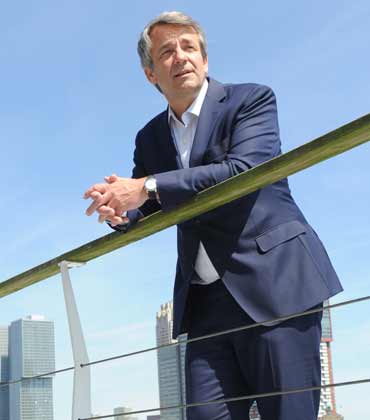
After obtaining an MBA in Economics at the University of Groningen, Leo Brand started his career at the airline KLM, where he worked in different positions for eight years, both in The Netherlands and in Germany. After KLM, he became manager at the strategic consultancy firm A.T. Kearney. In 2000 he co-founded the digital consultancy firm Adcore Strategy, where he took the helm as managing director. Brand was the pioneer in commercializing Wifi in the early days and co-founded Megabeam in London which was sold to Swisscom in 2003 where he also was the CEO for almost twelve years. Nowadays he is Vopak’s CIO since 2014 and is involved in different start-ups. He is a Supervisory Board Member for Autobinck NV and Innovation Quarter, a global port accelerator platform.
As the Chief Information Officer (CIO) at Vopak, could you provide an overview of your role and responsibilities within the company?
As the CIO for Royal Vopak I am responsible for a successful digital transformation of a more than 406 years old company. My position is part of the Exco. I manage a global team supporting the global and local business processes. Due to the current non stable situations in the world, cybersecurity is a key theme on the board agenda. As a result of successfully standardizing our processes during the last years, we are properly organized to protect our assets in an optimal way.
In addition I am the chairman of the Vopak Ventures Board which Vopak started 4 years ago. We invest in promising (digital) technologies and energy transition solutions. Over the last 4 years we invested in 20 companies around the world, e.g. I-IoT sensor producing company, capturing maintenance data for industrial sites using drones, LOHC (liquid organic hydrogen carrier technology), flow batteries, solar foil, etc.
I am also supervisory board member and chairman for Innovation Quarter ( a regional private-public investment fund Euro 170 mln) as well as board member for a family company Autobinck that needs to transform from a traditional car retail company into a Mobility as a Service (MaaS) company. Getting exposed to these other industries creates valuable experiences and learnings for my CIO role at Royal Vopak.
As a CIO, what are some of the key challenges you face in leveraging technology effectively?
a) One of the main challenges is to start using the enormous amount of data we collect and contextualize and create a stronger value proposition for our customers (data sharing and data monetization) as well as optimizing the cost of our assets, people, terminals and our positioning in the supply chain. The challenge is to educate the existing staff to change their ways of working using these new technologies such as ML and AI in a secure way.
“As we analyze the companies in detail before taking a stake, we get a very in-depth insight in the company and its industry peers.”
b) We have completely redesigned our IT landscape making us independent from costly monolithic ERP solution providers. We have implemented a PaaS solution (low code) for our most critical processes which enables us to differentiate our services from our competitors. For all non differentiating activities, e.g. HR, Finance, etc., we have implemented SaaS solutions based on standard global processes. This enables us to operate our terminals at competitive low IT cost levels by globalizing the governance and the processes of these services.
c) The industry is conservative and there are extra safety requirements needed. It needs a clear vision and strategy execution, including funding, to secure the changes in a complex ecosystem. Via one of our Vopak Ventures NxtPort, we have taken the lead to invest into the first global data sharing platform to tackle the issue of demurrage. The challenge is to secure sufficient players in the global supply chain at different locations to create the network effect a platform needs to create value for all its participants.
With the rapid pace of technological advancements, how to stay informed about emerging technologies and assess their potential impact?
To keep continuously informed I use a variety of channels. First of all, the venture activity provides us many useful insights by taking small equity positions in companies that develop complete new technology solutions. As we analyze the companies in detail before taking a stake, we get a very in-depth insight in the company and its industry peers. For example, we have taken a position in a Data Catalog company that is on the edge of using Knowledge Graph technology to manage data catalogs internal and external, data governance, data compliance and data access which we also use ourselves. Having board positions in some of these companies gives us continuous insights. In parallel we ensure we are active in a variety of communities as a member to get the latest insights and exchange experiences with other companies. Through these interactions we do receive valuable latest information about the possible impact of these new technologies.
What advice would you give to young professionals who are interested in pursuing a career in technology, and what qualities do you think are essential for success in this field?
My advice to the next generation is to secure affinity and understanding of all these new technologies by investing sufficient time. Through my career I learned “the ripple effect” in combination with the slogan: “you can only see the impact of new technologies when you understand them”. Looking back in history, the people and the companies that have been most successful were the ones that did understand these technologies at an early stage (“ripples”) and especially understood the impact on their company and sector when these new technologies would come together creating “big waves” of changes. The companies that did not see these waves coming do not exist anymore. I-IoT, ML, AI, Gen AI, 3D chips are all new technologies that will have a great impact on the way we live and operate our companies or manage our institutions. It will change the human machine interaction which in 5-10 years seems logical but today sounds very futuristic.
